Processing Recurring Payments
When a customer In the context of the Cloud Monetisation Platform, an individual or organisation who has signed an agreement to take goods and services from a service provider. A customer receives a bill associated with one or more subscriptions, and can be a single end user or a large company with many subscriptions assigned to one agreement.’s bill payment becomes due, CMP Converged Monetisation Platform. The MDS Global product that supports customer care and billing for digital service providers. can automatically collect payments through the following payment schemes:
- UK Direct Debit Process
- Recurring Card Payments.
UK Direct Debit Process
Direct Debit payments due to be paid are extracted from CMP in the Direct Debit extract. Customers who have payments due are identified using the calculation: current date + predefined number of days.
Direct Debit extracts are transmitted to BACS Bankers Automated Clearing Services. A system in the United Kingdom for making payments directly from one bank account into another. via a third party Of software; a reusable component developed to be either freely distributed or sold by an entity other than the original vendor of the development platform. Payment Handler for processing.
BACS processes Direct Debits in accordance with the following Payment Cycle:
- Day One – Input – Direct Debit details transmitted to BACS.
- Day Two – Processing – Accepted data is processed (the working day before Entry day).
- Day Three – Entry – Direct Debits are debited or credited to destination Bank accounts.
CMP posts transactions to the CMP Sales Ledger when Direct Debit Extracts are transmitted, assuming success of the payment.
Transactions are immediately posted to the Sales Ledger with a calculated Posting Date representing when the customer’s bank account In the Cloud Monetisation Platform, a billing entity that can be used to manage payments on one or more subscriptions or payments for services. An account can hold details such as payments or invoices. is debited or credited - BACS Processing Date (Day Two) + 1 day - and CMP determines if that is a valid BACS date.
BACS processing occurs on working days (Monday - Friday with the exclusion of Bank Holidays); so the date is incremented until a valid BACS day is found.
UK Direct Debit Refunds
Authorised Direct Debit refund requests yet to be processed are also extracted from CMP in the Direct Debit Extract.
Refund transactions are posted to the Sales Ledger using the calculated Posting Date representing when the customer’s bank account is credited.
Where a customer has both a due debit amount and an approved refund, CMP creates two separate transactions in the Direct Debit extract.
UK Direct Debit Rejections (ARUDD)
Payment and rejection details are returned to CMP in the Automated Return of Unpaid Direct Debit (ARUDD Automated Return of Unpaid Direct Debits. The automated system used by the banks to return unpaid Direct Debit payments.) files if the bank is unable to process the payment. ARUDD files are collected from the third party Payment Handler for processing by CMP.
A reversal of the payment is applied in the CMP Ledger and the invoice is reopened during ARRUD processing.
Each returned payment includes a reason code. Configurable CMP parameters determine whether a Hard or Soft Decline has been returned and the required process to be carried out:
- Soft Declines are a result of a temporary error. Payments with Soft Decline can be retried a specific number of times by including the failed payment on a future Direct Debit extract. The number of retries for a specific reason code is configurable in CMP. Once the maximum number of retries is reached the Direct Debit payment is cancelled and treated as a Hard Decline.
- Hard Declines are permanent errors and are not retried. A Hard Decline results in CMP automatically changing the customer’s Payment Type to the configured default.
Each BACS reason code and number of retries for Soft Declines has an associated Workflow Event and the appropriate actions to be automatically completed depending on the failure reason.
UK Direct Debit Refund Rejections (ARUCS)
Rejected refund details are returned to CMP in the Automated Return of Unapplied Credits Service (ARUCS Automated Return of Unapplied Credits Service. A service related to the BACS payment system that allows the receiving bank to return the BACS Direct Credit automatically to the organisation via the BACS service and provide appropriate information (reason codes) as to why the payment was unapplied.) file if the bank is unable to process the payment. ARUCS files are collected from the third party Payment Handler for processing by CMP.
Refunds are manually reversed in the Sales Ledgers by the Managed Service MDS Global can operate an instance of CMP as a billing and customer management service on behalf of a service provider. In this situation, CMP is referred to as a Managed Service. and a Workflow Event is raised with the refund rejection details.
Rejected refunds are not retried. If required, the refund must be manually raised again by the appropriate Service Provider The owner of the infrastructure in which accounts will be created. The Service Provider can host and operate the instance of CMP, or CMP can be provided as a Managed Service. team.
Recurring Card Payments
CMP’s Recurring Card Payment process identifies all accounts with a Payment Type of Credit Card or Debit Card that have an Open Balance due to be paid.
A request is passed to the Payment Provider for each payment due. Once submitted the payment in CMP is updated to a status of Pending, restricting the payment from being resubmitted until a response is received.
The Payment Provider will return a response code indicating whether a payment has been successful:
- If a payment is successful, the successful payment response code is recorded and the payment is posted to the CMP ledgers.
- If a payment is unsuccessful, the unsuccessful response code is recorded and the required Workflow Event is raised, triggering any actions required. No amount is posted to the CMP ledgers.
Optionally, a Minimum Payment Amount can be specified in CMP. That is, if the Open Amount to be collected is below the minimum amount, the payment will not be requested.
Stored Card Refunds
Credit or debit card refunds can be completed only if supported by the third party Payment Provider.
Standard Refund functionality is used to create the refund request in CMP before redirecting to the third party Payment Provider to complete the transaction.
Integration to third party Payment Providers is assessed on a per Service Provider basis.
Generic Recurring Credit Card Payments
The CMP Generic Credit Card Payment interface provides a standard, generic output and input format for the handling of recurring credit card payments. The interface assumes the card details have been stored in a secure manner in the payment provider system:
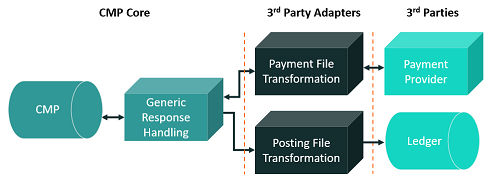
The generic recurring credit card payment functionality extracts payments and refunds from CMP when they are due and includes them in a generic JSON JavaScript Object Notation. JSON is a lightweight format for storing and transporting data, often used when data is sent from a server to a web page. file.
The JSON formatted files can be converted by a third party adapter to the required format expected by the payment provider. Once extracted, the customer's account Balance is updated.
Third party adapters can be created by MDS Global, Service Providers, systems integrators etc.
Payment response files, typically for errors only, can be processed back into CMP in a JSON formatted file. An adapter can again be used to convert files to the required file format if the payment provider cannot confirm to the JSON format expected. Depending on the error, the payment may be retried (soft decline) or the customer's payment type will be changed to facilitate collection via alternative means (hard decline).